Whisper vs YouTube Captions: When to Pay for Transcription
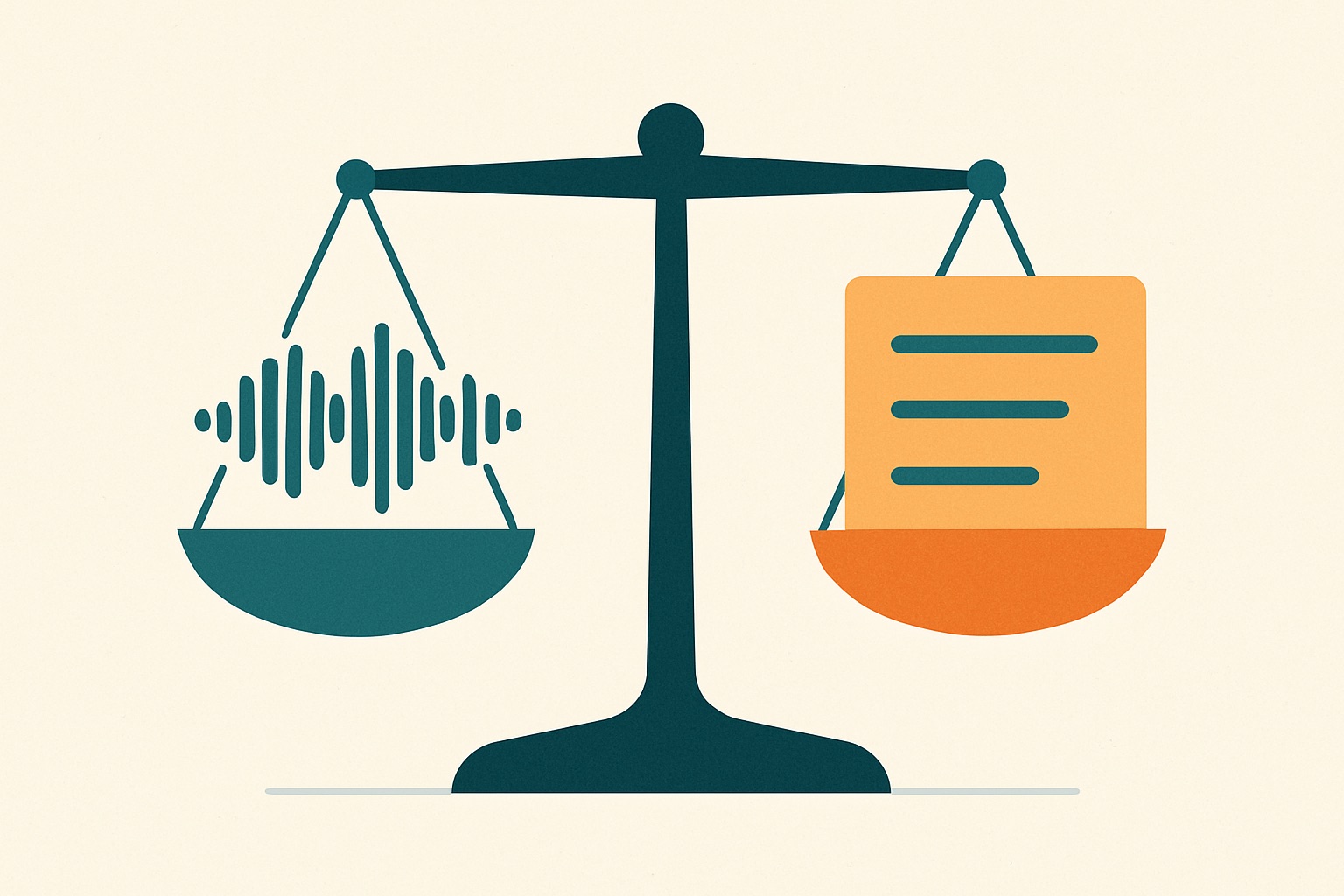
Whisper vs YouTube captions is a decision most people frame wrong. It gets treated as a quality shootout — which transcriber is "better" — when it's really a question about whether the transcript already exists. For the large majority of YouTube videos, it does: YouTube auto-generates captions, and fetching them is one HTTP call. Running Whisper on those videos means downloading audio, paying for compute, and waiting, to recreate text that was sitting there the whole time.
But Whisper isn't hype either. There are specific situations where it's clearly the right call, and if you're building a pipeline you'll eventually hit them. Here's the fair split, with numbers.
What each one actually gives you
YouTube captions — available instantly for most public videos. Human-uploaded tracks are excellent; auto-generated ones are decent and improve yearly, with the classic weaknesses: thin punctuation, mangled proper nouns and jargon, occasional homophone swaps. Cost to retrieve: effectively zero.
Whisper (or faster-whisper) — transcribes the audio itself. Real punctuation and casing, better handling of technical vocabulary (especially with an initial prompt), solid word-level timestamps, and it works on videos that have no captions at all. Cost: the OpenAI API is about $0.006 per audio minute; self-hosting needs a GPU or a lot of CPU patience. And you must first obtain the audio — typically via yt-dlp — which drags in its own problems on servers (datacenter IP blocking, binary maintenance).
The math on a 100-video backlog
Say you're processing a channel's back catalog: 100 videos, averaging 15 minutes.
Whisper route: 100 × 15 min × $0.006 = about $9 in API charges. Sounds cheap — and it is — but that's not the full bill. You also need to download roughly 100 audio files through yt-dlp (from a cloud IP, expect "Sign in to confirm you're not a bot" failures and proxy costs), store them, queue the jobs, and wait. Realistically this is an afternoon of pipeline work plus an hour-plus of wall-clock processing.
Captions route: 100 GET requests. Done in a couple of minutes, no audio ever touches your disk:
curl -s "https://youtube2text.org/api/transcribe?url=VIDEO_ID" \
  -H "x-api-key: yt_YOUR_KEY"
On youtube2text.org pricing, 100 videos fits the $9.99/month plan (500 videos). Similar dollar figure to Whisper's API charge — but zero infrastructure, and the results arrive as clean JSON immediately. When I'm feeding transcripts to an LLM for summarization or channel-scale RAG, this is the route every time; language models shrug off the small transcription errors in auto-captions.
Where Whisper genuinely wins
I want to be clear-eyed here, because there are jobs where captions lose outright:
- No captions exist. Some videos — unlisted uploads, certain music content, some non-English videos — return
TRANSCRIPT_UNAVAILABLE. Whisper is the only option. - Accuracy is the product. Publishing quotes, legal or medical review, subtitling your own content — auto-captions' error rate is unacceptable and Whisper's output is markedly cleaner.
- You need reliable word timestamps for clipping, karaoke-style highlighting, or alignment work. Caption timing is segment-level and approximate.
- Hard audio. Heavy accents, crosstalk, poor recordings — Whisper's large models often beat YouTube's ASR.
For lecture notes and podcast summarization, though, captions are almost always sufficient — the LLM downstream papers over the noise.
The decision list
- Feeding an LLM (summaries, RAG, research)? → Captions. Errors wash out.
- Publishing the transcript verbatim? → Whisper, then human review.
- Need word-level timestamps? → Whisper.
- Bulk backlog on a budget and a deadline? → Captions first.
- Video returns
TRANSCRIPT_UNAVAILABLE(404)? → Fall back to Whisper. This is the pattern I actually run: try the captions call, and only route the misses to a Whisper queue. In practice the fallback fires on a small minority of videos, so you get Whisper-level coverage at caption-level cost.
If your caption fetching keeps failing from a cloud server rather than returning results, that's a different problem — an IP block, not missing captions — covered in why youtube-transcript-api gets blocked.
To wire up the captions-first half: a free key is a Google sign-in away at youtube2text.org/app/keys (5 videos/month free, no card), and the full API reference lives at youtube2text.org/api.md.